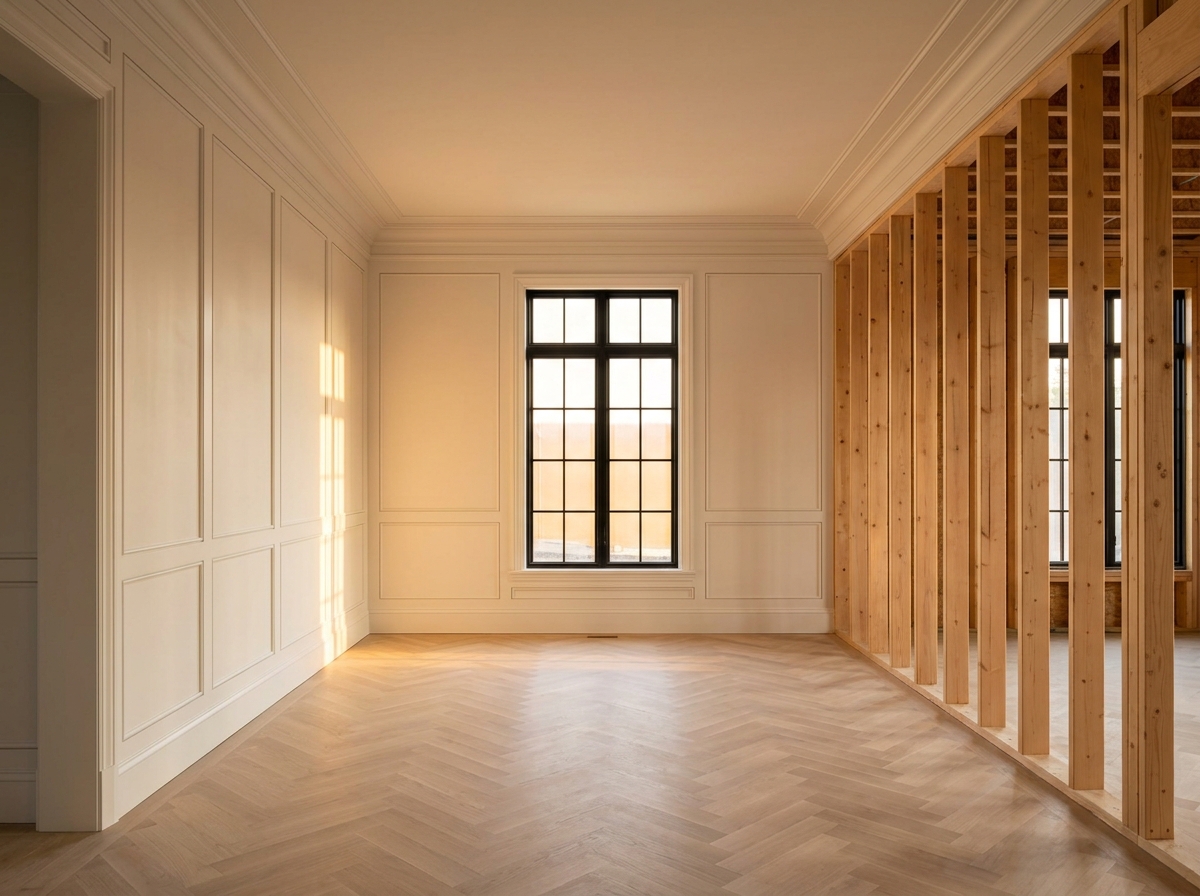
What a renovation timeline really looks like
Every renovation has two schedules. There is the one agreed at the start, which is tidy, sequential and optimistic. And there is the one the project actually runs on, which is mostly waiting punctuated by bursts of activity. The distance between them is predictable enough to plan for.
The tidy schedule fails not because anyone is incompetent, but because it models the wrong thing. It measures how long the work takes. Almost none of the delay on a typical renovation comes from work taking longer than expected. It comes from waiting — for a decision, for a permit, for a product that is eleven weeks out.
Understanding where the waiting lives is the difference between a project that runs three weeks over and one that runs three months over.
The phases, honestly described
Design and documentation
The phase clients most want to compress and the one where compression is most expensive. Every hour not spent resolving a detail on paper gets spent resolving it on site, where it costs more and gets decided by whoever is standing there. Drawings that specify what happens where the stone meets the joinery are worth more than drawings that show the room looking nice.
Permits and approvals
Almost entirely outside anyone's control, and highly variable by jurisdiction — a straightforward interior permit and one touching structure, egress or a historic district are not the same animal. Build in the realistic local duration rather than the best case, and start the application before the design is fully finished if the scope allows it.
Procurement
The phase that quietly determines the finish date, and the one most often left off the bar chart entirely. More on this below, because it deserves its own section.
Demolition
Fast, satisfying, and the moment the project learns what it is actually dealing with. Everything hidden becomes visible in about three days — the wiring nobody documented, the joist someone notched in 1974, the water damage behind the tiling. Expect the scope to move here. A contingency that has not been touched by the end of demolition is a contingency you may still need.
Rough-in and inspections
Framing, plumbing, electrical, HVAC. This phase has hard dependencies and inspection gates — work cannot be closed up until it has been signed off, and a failed inspection costs the re-inspection wait, not just the fix. This is where a well-run site pulls ahead, by sequencing trades so nobody is waiting on the trade in front of them.
Finishes
Plaster, joinery, tiling, painting, flooring, fittings. Slow, fussy, and where quality is visibly won or lost. It is also where accumulated procurement failures come due: if a tile arrived short, this is the week everyone finds out.
Punch list
Universally underestimated. The list is long, each item is small, and many require a specific trade to return for an hour. Coordinating six trades for six short visits takes longer than the work itself. Two to four weeks is realistic on a decent-sized project; two days is not.
Where the time actually goes
Two things account for most overruns, and neither is labour.
1. Long-lead items
Some products ship in days. Others are made to order and take months. The problem is that they look identical on a mood board, and the difference only surfaces when someone tries to order.
Items that routinely run long: custom joinery and cabinetry, stone slabs (selection, templating, then fabrication — three separate waits), made-to-order upholstery, specialist windows and doors, imported tile, custom lighting, and appliances in anything other than the standard finish.
The fix is unglamorous: identify long-lead items during design, not after contract, and order them first even if they are installed last. A stone slab selected in week two and fabricated in week fourteen is fine. The same slab selected in week fourteen is a six-week delay affecting every trade behind it.
2. Decisions
The most common cause of delay on well-run projects is a decision nobody realised was blocking anything. Grout colour sounds trivial. It is trivial — until the tiler is booked for Tuesday and cannot start, and the next slot is eleven days out because that crew has moved to another site.
A decision has a deadline whether or not anyone writes it down. The only choice is whether that deadline is discovered in advance or on the morning it is missed.
The remedy is a decision schedule that runs alongside the build programme: every choice the project needs, the date it must be made, and what stops if it is not. Clients handle this well when they can see it. What they handle badly is being asked for six decisions in one phone call, all urgent, with no context.
A realistic shape
For a substantial single-room renovation — a kitchen, a primary suite — a defensible shape looks roughly like this, with the caveat that every property and jurisdiction differs:
- Design and documentation — 4 to 8 weeks, longer if the scope is still moving.
- Permitting — highly variable; runs in parallel with procurement where possible.
- Procurement — begins during design and never really stops. The critical path lives here.
- Demolition — under a week, plus whatever it uncovers.
- Rough-in and inspections — 2 to 4 weeks, gated by the inspection calendar.
- Finishes — 4 to 8 weeks, the longest continuous stretch on site.
- Punch list — 2 to 4 weeks.
Add them and the number is larger than most clients expect, which is the point of writing it down. A schedule that is honest at the start is a much easier conversation than one that is optimistic at the start and revised monthly.
What protects a schedule
Three habits do most of the work:
Front-load the decisions. Every choice resolved before demolition is a choice that cannot delay a trade later. The goal is to arrive on site with nothing outstanding, knowing you will not fully manage it.
Order long-lead items first. Reorder procurement by lead time rather than by installation sequence. It feels wrong to buy the last thing first, and it is almost always correct.
Say what the contingency is for. Both the money and the weeks. A project with a stated four-week contingency that finishes two weeks late has landed early. The same project with no stated contingency has finished six weeks late. Identical outcome, entirely different experience — and the difference is a sentence in a document at the start.
The part worth saying out loud
Clients rarely get upset about a renovation taking a long time. They get upset about a renovation taking longer than they were told, which is a different failure and an avoidable one.
The projects that end well are usually not the fastest. They are the ones where the schedule was honest on day one, the decisions were mapped before the noise started, and the slow-moving items were ordered while there was still time for them to be slow.